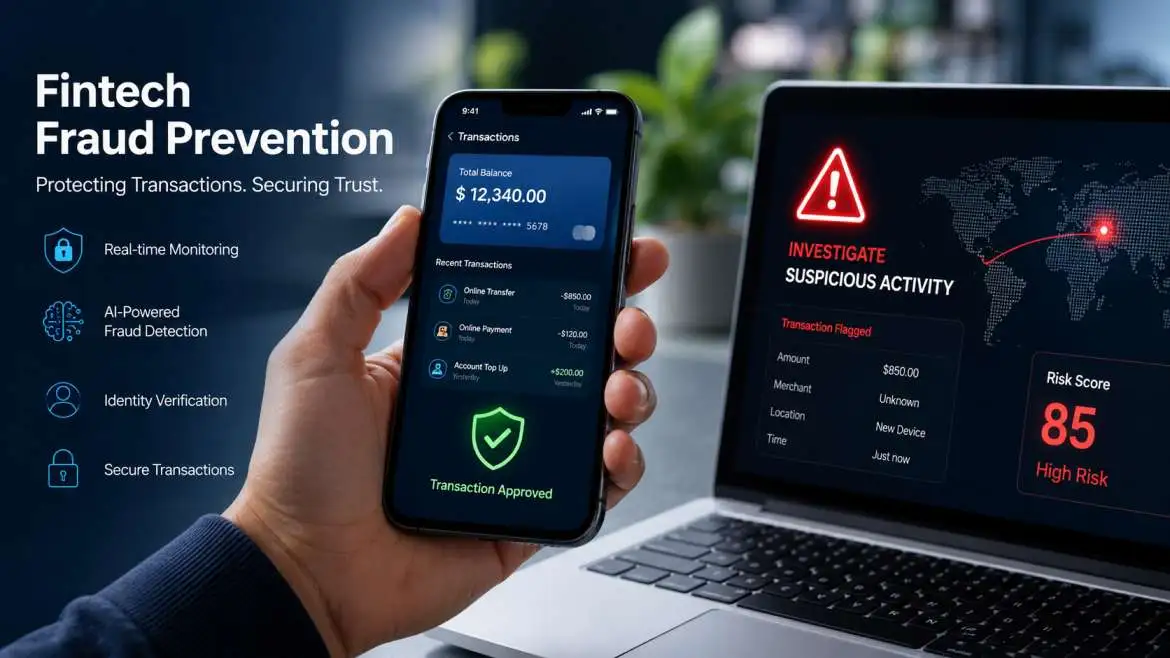
Payment fraud does not happen by accident. It is planned, tested, and repeated until someone stops it. Fintech companies sit directly in the path of that money, which means they cannot treat fraud prevention as a side project. Every transfer, every card tap, and every new account opening carries a small chance that the person on the other side is not who they claim to be.
The numbers explain why this work matters. Global card fraud losses reached $33.41 billion in 2024 . Scammers pulled $1.03 trillion from people worldwide in the same year . Those are not abstract figures. They represent real losses that fintech companies either absorb, pass to customers, or spend heavily to prevent.
What follows is a close look at the systems and decisions that keep payment fraud from becoming a daily crisis. The goal is not to list tools. It is to explain how those tools work together, why each layer exists, and where the weak points remain.
The Fraud Problem Fintech Companies Actually Face

Before understanding prevention, it helps to see what fintech companies are defending against. Payment fraud takes several shapes, and each one requires a different response.
Account takeover happens when someone gains access to a real customer’s account. They might have stolen a password, tricked the customer into sharing a login code, or found a weakness in how the company verifies identity. Once inside, they can change contact details, add new payees, and move money out before anyone notices.
Card testing is a volume game. Criminals buy stolen card numbers in bulk and need to know which ones still work. They run small transactions through checkout pages to see which cards get approved. A fintech company that does not catch this pattern becomes a testing ground for stolen data .
Authorised push payment fraud is harder to spot because the customer approves the payment themselves. They have been manipulated into believing the transfer is legitimate, often by someone pretending to be a romantic partner, an investment advisor, or even a bank employee. The transaction looks normal on the surface because the customer really did press the button .
Synthetic identity fraud involves creating a person who does not exist. Criminals mix real details with fake ones to build a credit history and open accounts. Standard checks often fail because parts of the identity are genuine .
Each of these attacks looks different in the data. A system built only to catch stolen cards will miss a customer who has been tricked into sending money to a scammer. A system built only for scams will miss automated card testing. This is why fintech companies cannot rely on a single check.
Read Also: Neobank Vs Traditional Bank Differences
Device Intelligence: Reading the Signals Before Money Moves
Long before a payment is approved, the device making the request is sending information. Fintech companies have learned to listen.
Device intelligence goes beyond simply asking what kind of phone or browser is being used. It collects hundreds of small details to build a “device fingerprint” . These details include the screen size, the browser type, the internet protocol address, and whether the device is on a call while using the app. On their own, none of these details prove anything. Together, they create a pattern that can be compared against what the company knows about the fintech companies prevent payment fraud.
Consider a simple example. A customer usually logs in from a phone in one city, using the same browser, at roughly the same times each week. One day, a login attempt comes from a different device, in a different country, through a virtual private network. The password is correct. But the device fingerprint does not match. The system flags the session for additional checks before any money moves.
Fintech companies also look at indirect signals. If the login location is physically farther from the nearest cell tower than makes sense, that inconsistency matters . If the device claims to be in one place but travels an impossible distance in a short time, that matters too. These signals do not automatically block a transaction. They raise the risk level, which triggers other checks.
Behavioural Biometrics: Watching How You Interact
Physical biometrics like fingerprints and facial scans are familiar. They confirm who you are at a single moment. Behavioural biometrics work differently. They watch how you use the device, continuously, in the background.
The system measures things like how quickly you type, how much pressure you apply to the screen, and the way you swipe or scroll . A fraudster who has stolen your password will not type the same way you do. They will not hold the phone at the same angle or navigate through the app with the same rhythm. These differences are subtle, but they are measurable.
What makes this approach powerful is that it does not require the customer to do anything extra. There is no additional code to enter, no security question to answer. The verification happens silently while the person uses the app. If the behaviour matches the known customer, the session continues smoothly. If it diverges sharply, the system can step up verification or hold the transaction for review.
The Federal Reserve has highlighted behavioural biometrics as one of the more effective tools for detecting fraud because it works continuously rather than at a single checkpoint . A stolen password becomes far less useful if the person using it cannot mimic the real customer’s physical habits.
Risk-Based Authentication: Fewer Annoying Interruptions, Better Security
Multi-factor authentication is a strong security measure. But when every transaction triggers a code or a prompt, customers get tired. They start approving requests without reading them. The Federal Reserve calls this “notification fatigue” . When people stop paying attention, the security measure stops working.
Risk-based authentication takes a different approach. It looks at the transaction first, then decides whether extra verification is needed . A small payment to a regular contact, made from the usual device, at a normal time, might go through without interruption. A large payment to a new recipient, made from an unfamiliar device, late at night, triggers a verification step.
This approach does two things well. It reduces the number of interruptions for legitimate customers, which keeps them engaged and less likely to abandon the service. And it concentrates the friction on transactions that actually look risky. A criminal trying to move stolen money will face more hurdles because their behaviour and device create signals that legitimate customers do not.
The key is that risk-based authentication is not a single rule. It is a continuous assessment. The system weighs the device, the behaviour, the transaction details, and the recipient history together. No single signal decides the outcome. The combination does.
Machine Learning and Rules: Two Tools, Not One Replacement for the Other
Fintech companies use two broad approaches to spot fraud in transaction data. They need both.
Rules are straightforward. If a transaction matches a known bad pattern, it gets blocked or flagged. A rule might say: block any payment from an internet protocol address that has been linked to fraud before. Or: flag any account that attempts five small transactions in under a minute. Rules are fast, transparent, and easy to audit. When a transaction is blocked, the company can point to the exact rule that triggered the decision .
The problem with rules is that they only catch what someone has already thought to write down. A rule written to stop one type of card testing will not catch a slightly different version. Criminals adapt, and rules require constant updating.
Machine learning models work differently. They look at combinations of signals across millions of transactions and learn what fraud tends to look like in the data. They can spot patterns that no human wrote a rule for . When a new fraud method appears, the model may catch the anomaly before anyone has defined a rule for it.
The weakness of models is that they are harder to explain. A model produces a risk score, not a simple reason. When a legitimate customer gets blocked, the company needs to understand why so it can fix the problem. Modern systems address this by providing reason codes alongside the score .
Stripe, which processes payments for millions of businesses, describes its approach as combining rules engines and machine learning models . The rules handle known threats quickly. The models catch the variations and new patterns. Neither one alone is enough.
Read Also: How Fintech Innovations Changed My Financial Life
Network Intelligence: Seeing Fraud Across Many Companies at Once
A single fintech company sees only its own transactions. If a fraudster uses a stolen card at one business and then moves to another, the first company might catch the fraud, but the second company has no way to know. Network intelligence changes that.
When a fraudulent actor uses a stolen card or a suspicious device at one business on a network, that information becomes available to protect other businesses on the same network. Stripe reported that its Radar system flagged a fraudulent internet protocol address and device fingerprint across bank debits, digital wallets, and buy now pay later transactions after detecting fraud at one business . The same signal protected other transactions network-wide.
Visa offers a similar approach for account-to-account payments. Its A2A Protect system uses network-level scores that draw on fraud signals from across the payments ecosystem . When a bank opts in, it can see risk patterns that would be invisible from its own data alone. In a case study with Pay.UK, the system detected 54% of total fraud and scam value beyond what the bank’s own systems identified, while reducing false positives by 40% .
The logic is simple. Fraudsters reuse tools. They use the same devices, the same internet addresses, the same stolen identity details. When one company sees those tools used in an attack, sharing that signal helps every other company recognize the same tools before the next attack succeeds.
The Recovery Problem: When Prevention Fails
No system stops every fraud attempt. Fintech companies know this, which is why the response after a fraudulent transaction matters as much as the prevention before it.
For instant payments, recovery is extremely difficult. Once money settles in near real-time, it is gone . This reality has pushed the industry toward new models that combine prevention with dispute resolution and recovery processes.
Mastercard’s A2A Protect, launching in the UK, combines real-time transaction scoring with a standardized framework for banks to resolve disputes and recover funds . The service addresses authorized push payment fraud specifically, where the customer approved the payment but was deceived. The framework gives banks a clear process for handling claims and recovering money where possible.
Visa’s A2A Protect takes a similar approach, focusing on stopping fraud before money leaves the account. The system provides millisecond decisioning for instant payments, giving banks a chance to intervene before settlement . Both companies are building products around the understanding that prevention alone is not enough. Customers need to know that if something goes wrong, there is a process for addressing it.
The Human Layer: Where Technology Ends and People Begin

Technology catches patterns. People catch stories. Some fraud, especially scams that manipulate the customer into approving a payment, does not look abnormal in the data. The device is right, the behaviour is right, and the transaction details match what the customer usually does. The only thing wrong is the reason behind the payment.
This is where customer interaction becomes a fraud prevention tool. The Financial Conduct Authority in the UK reviewed how firms handle romance fraud and found that tailored engagement with customers made a real difference . Staff who asked thoughtful questions, shared information about known scam patterns, and followed up with customers helped victims recognize what was happening and stop further payments.
One firm made eleven calls over six weeks to support a victim . That is not a technical solution. It is a human one. But it works because it addresses the part of fraud that technology cannot reach: the manipulation of fintech companies prevent payment fraud.
Fintech companies are also building this into their products. Customized risk notifications tell customers exactly why a transaction looks suspicious, naming the payee and the amount, and requiring a direct response before the payment proceeds . Instead of a generic warning that customers learn to ignore, the alert contains specific details that prompt real engagement. The customer becomes an active participant in their own security.
What Good Prevention Looks Like in Practice?
A fintech company with strong fraud prevention does not rely on any single method. It layers device intelligence, behavioural analysis, risk-based authentication, machine learning, rules, and network signals together. Each layer catches something the others miss.
The goal is not to block every transaction that looks slightly unusual. That would frustrate customers and damage the business. The goal is to make fraud expensive and difficult for criminals while keeping legitimate payments fast and smooth. Risk-based authentication reduces friction for the honest majority. Device and behavioural signals raise the cost for the dishonest minority. Network intelligence means that one company’s detection protects others.
Stripe’s custom fraud models illustrate the direction the industry is moving. Businesses can pass their own signals, such as product data or loyalty status, to Stripe, which combines that information with its global network data to build a model specific to that business . In early tests, the custom models detected at least 15% more fraud without increasing false positives . The model learns from both the individual business and the broader ecosystem.
That is the balance fintech companies are trying to strike. Fraud prevention works best when it is specific enough to catch real threats, broad enough to learn from what others see, and invisible enough that legitimate customers never notice it.
The Work That Never Ends
Payment fraud prevention is not a problem that gets solved and then set aside. The threats change. Generative artificial intelligence is now being used to create fake identities and realistic deepfake videos and audio . Legacy systems that rely only on rules struggle to detect these new attacks. The industry response has been to move toward multi-layered defenses that combine advanced signals rather than depending on any single check.
For fintech companies, the work is continuous. Every new payment method, every new market, and every new customer segment brings new fraud patterns. The companies that handle this well are the ones that treat prevention as a core part of their product, not a cost center. They invest in data, they share signals where they can, and they remember that behind every transaction is a person who expects their money to be safe.